Note: This post was written by Jason Edison, co-author of OSINT Techniques.
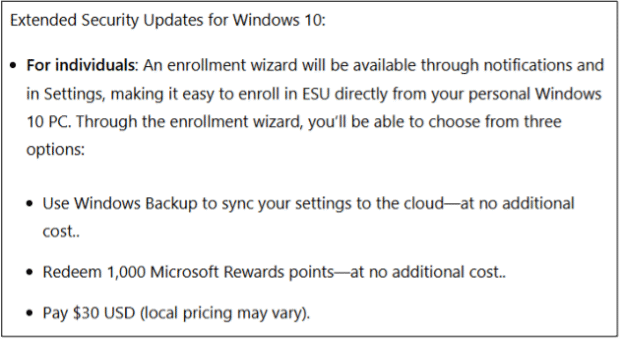
We are now approaching the October 2025 sun-setting of support for Windows 10. As a follow up to their previous announcements regarding post 2025 support, Microsoft recently announced additional options for those who wish to stay with Windows 10. I will not bury the lead: all of the options provided by Microsoft are bad for any privacy-minded users unless they want to shell out additional money for paid support. Let’s first look at the pitch and then at the end of this article I will share my own strategy. The following graphic is the summary of options posted on Windows.com:
Source: https://blogs.windows.com/windowsexperience/2025/06/24/stay-secure-with-windows-11-copilot-pcs-and-windows-365-before-support-ends-for-windows-10/
You might think, okay, I’ll just buy myself out of this problem by paying the $30 extension fee. This is a yearly fee so essentially they are pushing you back into a subscription to receive proper support for a product that you already own. Using Microsoft points does not change the fact that it is a subscription fee. The only difference is that you are using their proprietary “currency” which for most people is an even worse option.
As is common in these modern times, they are happy to provide a new alternative where you can trade your data for the right to continue using the software you already own. If you are already deep into the Microsoft cloud storage and services, you may not take issue with this, but the fact that you are reading this blog infers that you value your privacy and security. Having to store your workstation settings in Microsoft’s cloud seems like a horrible idea. It means giving up even more control of your sensitive data.
The final option is to do what Microsoft really wants us to do, which is to comply and accept being forced into using Windows 11. First of all, not all hardware supports Windows 11, so this may require a significant hardware upgrade. Secondly, Windows 11 has even worse privacy implications than Windows 10 as well as being a far more “locked down” operating system. Anyone who has put effort into customizing their Windows 11 installation knows the pain of trying to remove the various unwanted “features” which harvest your personal data while also limiting your ability to customize your user experience. Then there is the Copilot (Microsoft’s AI assistant) integration which they seem intent on forcing upon all of us.
You might be wondering at this point if I am just a Microsoft hater. Actually, Windows has been my primary operating system my entire adult life. Although Windows continues to offer some of the best broad application compatibility, each new version has been less privacy-respecting while also offering less control to users over their own systems. I would not tell anyone what choice they should make but I decided earlier this year to migrate to Linux as my primary daily operating system. This journey is not complete, but I will be posting a follow up article sharing some of my experiences as well as some tips and resources for others who may choose to head down the Linux rabbit hole as an alternative to submitting to Microsoft’s non-privacy respecting business practices.